Google Ends Cache-Served AMP Pages In Search: What This Means for Publishers and SEO
Something quietly shifted on July 1, 2026. Not a ranking update. Not a core algorithm change.
But it matters if you still have AMP on your site.
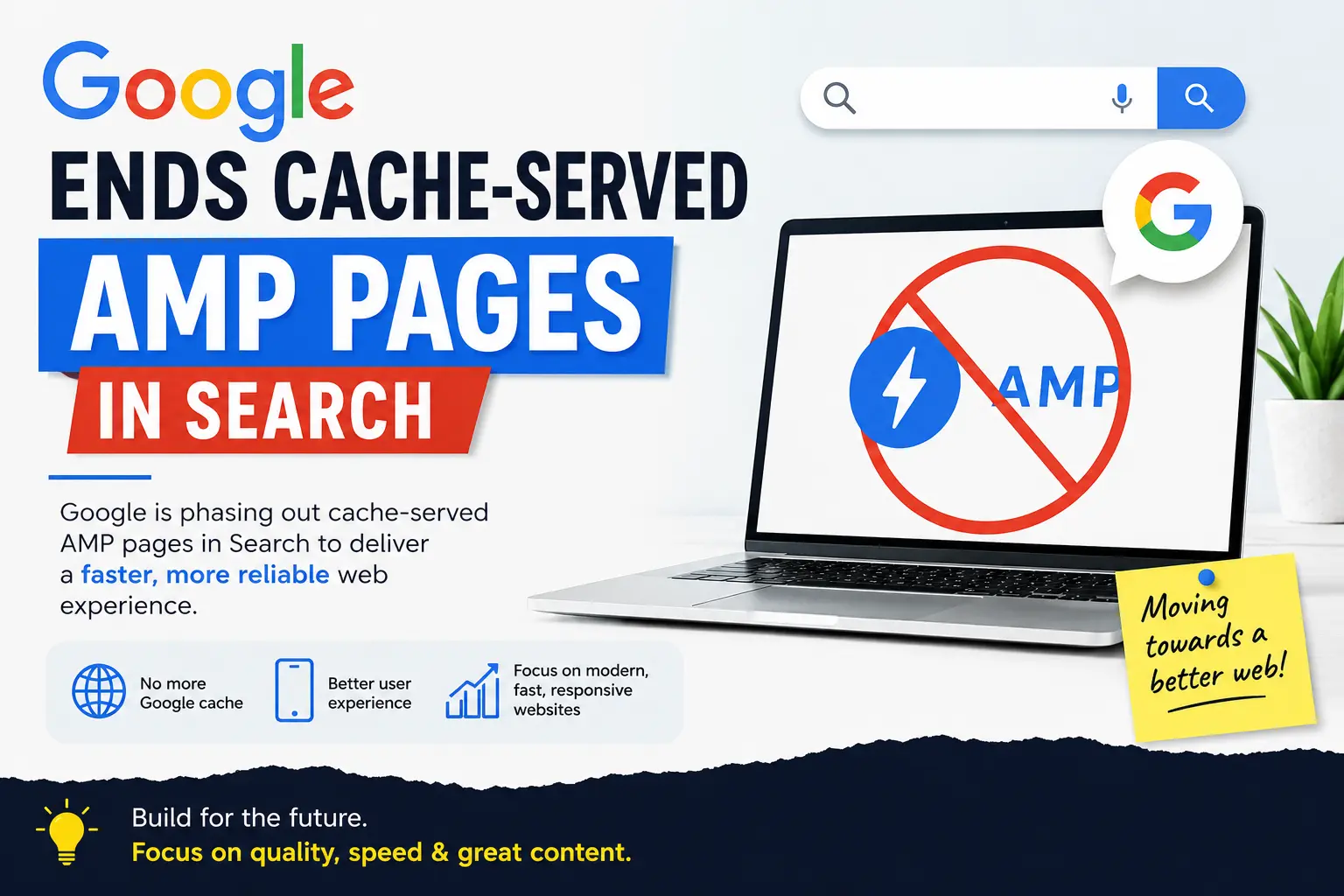
Google ended the cache-served path for AMP pages in Search. As of July 1, clicking an AMP result takes you directly to the domain's AMP host page — not a version served from Google's AMP Cache.
That might sound small. It isn't. Here's why.
What Actually Changed
For years, the AMP experience in Google Search worked like this: you click an AMP result, Google pulls a pre-cached version of the page from its own servers, and you land on a URL that looks like google.com/amp/yoursite.com. The page loaded fast. But it wasn't really your page. It was Google's copy of it.
Now Google will send searchers directly to publisher-hosted AMP pages instead of cached pages displayed in an AMP viewer. Google confirmed this was done because it "simplifies and reduces maintenance efforts for publishers who are creating AMP content."
In practical terms, Google removed mentions of the AMP viewer, AMP Cache, and signed exchanges from its AMP documentation. Signed exchanges previously let a domain's original URL appear instead of the Google-hosted version.
The result is cleaner. When someone clicks an AMP result now, they land on your actual URL. Not a Google-wrapped version of it.
What Hasn't Changed
Before you panic, let's be clear on what this update does not affect.
Google Search remains unchanged in terms of how it ranks AMP pages within the search results. The serving and ranking of AMP content in Google Search and Google Discover will remain the same.
So if your AMP pages were ranking before July 1, they're still ranking the same way now. No positions dropped. No indexing impact. This is purely a serving change, not a ranking one.
Google also confirmed that publishers "no longer need to update the AMP Cache or configure signed exchanges." That's actually one less maintenance task for site teams still running AMP infrastructure.
A Brief History of How We Got Here
AMP launched in 2015 with one goal: make mobile web pages load faster. At the time, it worked. Pages served from the Google AMP Cache loaded almost instantly because Google pre-fetched and pre-rendered them on its own CDN before you even tapped the link.
Publishers adopted it fast. Not always by choice. Google prioritized AMP pages in Search Results, particularly in the Top Stories carousel, which put serious pressure on news sites to implement it or lose visibility.
Then things started to shift.
The way Google serves AMP pages has gradually changed over the years, beginning in 2021, when Google dropped AMP as a requirement for the Top Stories carousel and retired the AMP lightning-bolt icon from search results.
That was the real turning point. Once Top Stories no longer required AMP, publishers had no incentive to maintain a separate AMP infrastructure. The migration away began immediately.
Major publishers including The Washington Post, CNBC, Vox Media, and others have migrated off AMP. Google's own guidance now points to Core Web Vitals on standard HTML as the performance benchmark that replaced AMP's role.
The July 2026 cache change is simply the next step in that long wind-down.
Why the Google AMP Cache Mattered — and Why Ending It Makes Sense
The Google AMP Cache was genuinely impressive engineering when it launched. It pre-rendered search results so that when an AMP link appeared in Google results, Google fetched the page in the background and served it from its own CDN, making the perceived load time near zero.
But it came with a trade-off most publishers resented. Most AMP pages were hosted on and served from Google's own servers, not the publisher's. This meant publishers lost control over how their content looked and how they made money from it.
That URL problem was a constant complaint. Sharing a google.com/amp link instead of your own domain link meant users and other sites linking to that content pointed to Google's copy, not yours. That has real implications for brand equity, referral traffic attribution, and link building.
Removing the badge erased the one clear visual edge AMP results had. The deeper change arrived a year later when Page Experience and Core Web Vitals became the yardstick. Once Google measured speed and stability directly, the format a page used stopped mattering — the experience it delivered did.
Ending the AMP Cache serving path is a logical conclusion of that progression.
What This Means for Sites Still Running AMP
If your site still has active AMP pages, here's what to think about.
- Your rankings are safe: Nothing in this change affects how AMP pages in Search Results are ranked or discovered. Indexing continues as normal.
- Your URLs are now yours: Clicks from Search will land on your actual AMP host page. That's a better experience for users and better for your own analytics attribution.
- You still need fast pages: The reason AMP pages ranked well wasn't the AMP format itself — it was the page speed advantage the Google AMP Cache provided. Now that caching advantage is gone. Your AMP host pages need to be genuinely fast on their own.
- Modern CDNs and HTTP/3 protocols now deliver similar or better speeds without relying on AMP Cache. If your AMP pages are slow when served directly from your server, now is the time to fix that.
- You no longer need to maintain the AMP Cache: Google confirmed publishers no longer need to push updates to the AMP Cache or configure signed exchanges. That removes a layer of technical overhead for teams still maintaining dual page versions.
Should You Still Use AMP at All?
Honest answer: probably not, if you're starting from scratch.
Google no longer gives AMP pages any ranking advantage, the AMP badge is gone, Top Stories no longer requires AMP, and most major publishers have migrated away. For all practical SEO purposes, AMP is no longer a priority or a necessity.
Modern frontend frameworks like Next.js, Astro, Nuxt, and SvelteKit produce HTML that's already optimized for fast first paint. Modern hosting on Vercel, Cloudflare Pages, Netlify, and similar platforms achieves the instant-load effect that AMP Cache pioneered — without routing users through Google.
If you're already on AMP, the question is when to migrate, not whether. The July 2026 cache change accelerates that timeline. Without the Google AMP Cache doing the heavy lifting on speed, your AMP infrastructure needs to justify itself on its own merits.
For most sites, it can't.
What to Do Right Now
If you run AMP pages, here are the immediate actions worth taking.
- Test your AMP pages directly: Now that they load from your own host rather than the Google AMP Cache, check load speed, visual rendering, and mobile experience. Use PageSpeed Insights or Core Web Vitals reporting in Search Console.
- Check your analytics: Traffic attribution from AMP clicks will look different now. Sessions that previously registered as coming from google.com/amp will now show your own domain. Expect some fluctuation in referral and direct channel data.
- Monitor Search Console impressions and clicks: There's no ranking impact expected. But it's worth watching the data over the next few weeks to confirm your AMP pages in Search Results are performing normally.
- Consider migration timelines: If your team has been delaying an AMP-to-standard migration, this update removes the last performance argument for staying. Plan the migration with proper 301 redirects from AMP URLs to canonical pages, and verify Core Web Vitals on the destination pages before you deindex AMP versions.
The Bigger Picture
Google isn't killing AMP today. AMP content will continue to rank just like any other webpage. The framework still exists. AMP pages still work. AMP content still appears in Google Discover and Search.
But the infrastructure Google built to make AMP special — the cached serving, the AMP viewer, the signed exchanges — is being dismantled piece by piece.
The web that needed AMP no longer exists. The framework still functions, but as a ticket to better Google rankings, AMP has been outrun by the open web it was built to fix.
The July 2026 change is less a death announcement and more a quiet final chapter. AMP served its purpose. The web caught up. And Google is now stepping aside from the infrastructure it built to hold it all together.
If you're still running AMP, now is the right time to plan your path forward — not because Google is punishing you, but because the advantage is simply no longer there.
Leave A Comment
Popular Blog


Recent Blog

SEO vs Google Ads: Which Is Better for Business Growth?

Best Digital Marketing Agency for Small Businesses

How to Choose a Full-Service Digital Marketing Agency for Your Business Growth

8 Best Dental Digital Marketing Agencies in 2026


Published Comment