Google's June 2026 Spam Update Is Live: What Site Owners Need to Know Now
Google has officially confirmed the rollout of its June 2026 spam update. The announcement came through the Google Search Status Dashboard, with the rollout listed as an incident affecting ranking starting at 9:00 a.m. PT on June 24, and the release note posted at 9:03 a.m. PDT. Google's note was brief: "Released the June 2026 spam update, which applies globally and to all languages. The rollout may take a few days to complete."
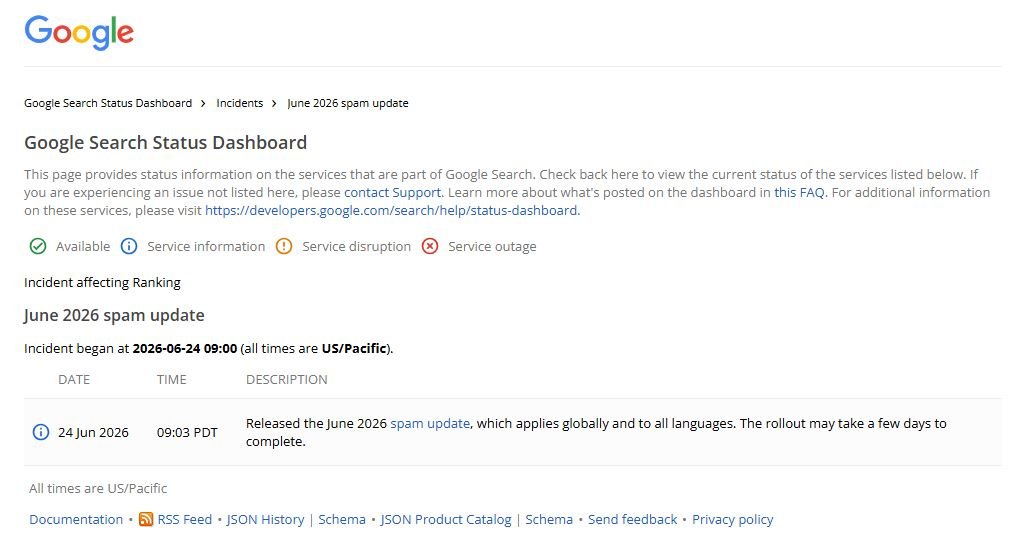
This marks the second spam update of 2026, following the March 2026 spam update. Notably, Google announced no new spam policies alongside this release, which suggests this is an enforcement refresh rather than a new rulebook.
What This Update Targets
Spam updates work differently from core updates. Google's spam updates documentation describes them as improvements to the automated systems that detect spam, including SpamBrain, Google's AI-based spam-prevention system, rather than broad changes to overall ranking signals like core updates make.
According to Google's standard spam policy guidance, sites that violate Google's policies may rank lower in results or not appear in results at all, and improvements can take months for Google's systems to reassess a site once changes are made.
One important caveat: if this turns out to be a link spam update specifically, sites won't necessarily see improvement just from making changes, because once Google's systems discount the effects of spammy links, any ranking benefit those links generated is permanently lost — it can't be regained.
Why the Timing Matters
This update doesn't exist in isolation. In May 2026, Google updated its spam policies page to state that manipulating AI responses in Google Search now counts as spam. In April 2026, Google published a back-button-hijacking spam policy that became enforceable on June 15, 2026 — just nine days before this rollout began.
Unlike March 2026, when a spam update overlapped with a core update and made diagnosis difficult, the June update appears to be rolling out on its own, making it easier for site owners to isolate the actual cause of ranking shifts.
What to Do Right Now
- Don't panic-edit: Checking and reacting to rankings mid-rollout creates noise, not insight.
- Annotate the date: Mark June 24, 2026 in Search Console so you can separate this update's effects from future changes.
- Audit against spam policies: not core quality guidelines — these require different fixes.
- Be patient with recovery: Genuine compliance fixes may take months to reflect in rankings.
If your site relies on original content and legitimate link-building, this update is unlikely to bring lasting harm. Sites built on scaled, templated, or manipulative content are the ones that should be auditing today.
Leave A Comment
Popular Blog


Recent Blog

SEO vs Google Ads: Which Is Better for Business Growth?

Best Digital Marketing Agency for Small Businesses

How to Choose a Full-Service Digital Marketing Agency for Your Business Growth

8 Best Dental Digital Marketing Agencies in 2026

Published Comment